
BEYOND THE STORM
Space weather.
A clearer view of the night sky.
Follow NOAA solar-storm conditions, explore the aurora forecast, and understand what could affect your view. Free tools. Clear sources. No promised sightings.
NOAA OBSERVATIONS
What’s happening in space?
Three different scales describe geomagnetic storms, solar radiation storms and radio blackouts. Each runs from 1 (minor) to 5 (extreme); zero means no storm on that scale.
Checking NOAA observation time…
Geomagnetic storms
Checking…Aurora activity and potential effects on power, navigation and satellites.
Solar radiation storms
Checking…Energetic particles with potential effects on satellites and polar communications.
Radio blackouts
Checking…Solar-flare effects on high-frequency radio on Earth’s sunlit side.
THE AURORA OUTLOOK
Where might the sky light up?
NOAA’s OVATION model gives a short-term view of aurora location and intensity, normally 30–90 minutes ahead. This is a regional forecast, not a guarantee of what you’ll see from your town.
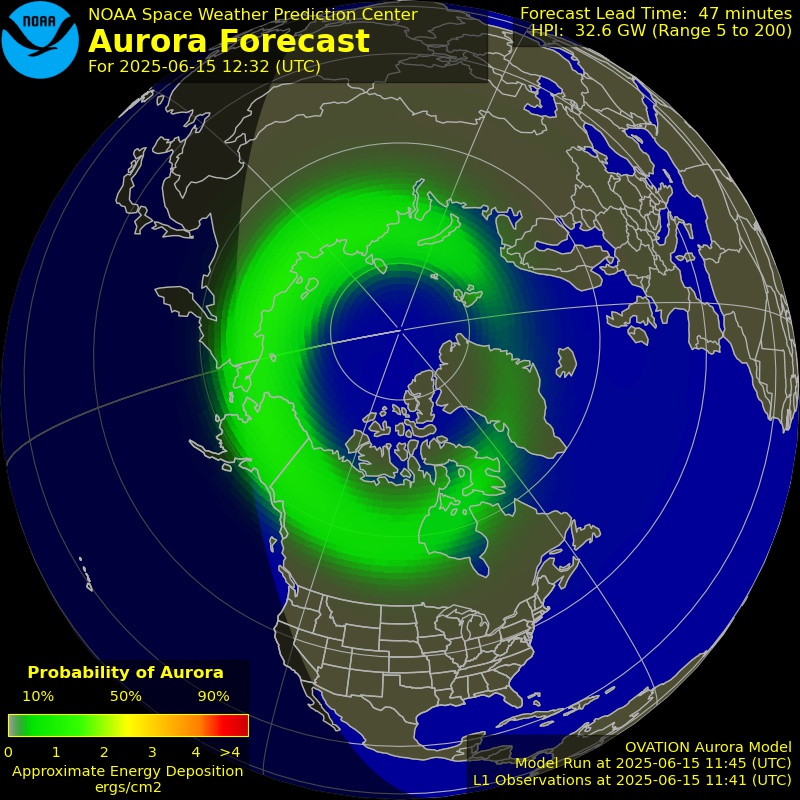
The aurora map is unavailable. Open NOAA’s forecast below, or try reloading the map.
BEFORE YOU HEAD OUT
A forecast is only part of the view.
A strong geomagnetic storm alone does not guarantee an aurora sighting. Your location, cloud cover and darkness matter too.
Read NOAA’s aurora viewing tips ↗- Check the forecast time. Recheck close to your viewing window; the outlook can change.
- Check local clouds. Use your local NWS forecast alongside the aurora map.
- Find darkness and an open horizon. Avoid bright lights, and use a safe, permitted viewing location.
- Keep expectations realistic. Camera images can look brighter or more colourful than the naked-eye view.
Understand the signals.
Does Kp tell me whether I’ll see the aurora?
Kp describes planetary geomagnetic activity. It is useful context, but it does not capture your clouds, darkness or exact viewing conditions. Use NOAA’s aurora map and local forecast together.
Why are there three storm scales?
Geomagnetic storms (G), solar radiation storms (S) and radio blackouts (R) describe different events and impacts. An event on one scale does not imply the same level on another. See NOAA’s definitions.
Is this a real-time aurora camera?
No. The map is a forecast from NOAA’s OVATION model. Use the times on the image to judge its age. If upstream solar-wind data are unavailable, NOAA may use a Kp-based estimate with no forecast lead time.
FUTURE MEMBER FEATURES · IN DEVELOPMENT
Make the weather desk yours.
We’re exploring saved viewing locations, configurable aurora notifications, cloud-and-darkness context and personalized summaries for Weather Desk Plus.
These features are proposed. There is no active aurora-alert subscription or paid membership for these proposed tools. Existing severe-weather alerts, radar and this hub stay free.
Explore the supporter preview →Aviation weather: tell us if it belongs here.
A favorite-airport dashboard, weather-change summaries and optional notifications are also being considered. Specialist tools will need aviation review before launch.
For airport observations (METARs), forecasts (TAFs), icing, turbulence and advisories, use the official Aviation Weather Center. These resources support weather awareness; this hub is not a flight briefing or a flight-safety decision tool.
Open official aviation weather ↗HELP SHAPE WHAT COMES NEXT
Interested in a more personal weather desk?
Feature-update email signup is not currently available. Saved aurora locations and aviation features are being explored. Severe-weather warning signup is separate and remains free.
Sending feedback does not subscribe you to alerts or a mailing list.
