
FLOOD ALERTS
Flash Flood Emergency vs. Flash Flood Warning.
Both mean flooding is happening or about to. An emergency means the flooding is catastrophic and lives are in danger right now. Here is what changes, and how to decide whether to leave or get higher where you are.
The short answer
A Flash Flood Warning means flash flooding is happening or about to happen where you are: move to higher ground now. A Flash Flood Emergency is the highest flood alert the National Weather Service issues. It is reserved for exceedingly rare cases when a flash flood poses a severe threat to human life and catastrophic damage is happening or imminent, often with water rescues already underway. It is not a separate product. It is a headline inside a Flash Flood Warning that carries the “catastrophic” damage threat.
Flash flood alerts: prepare, then act
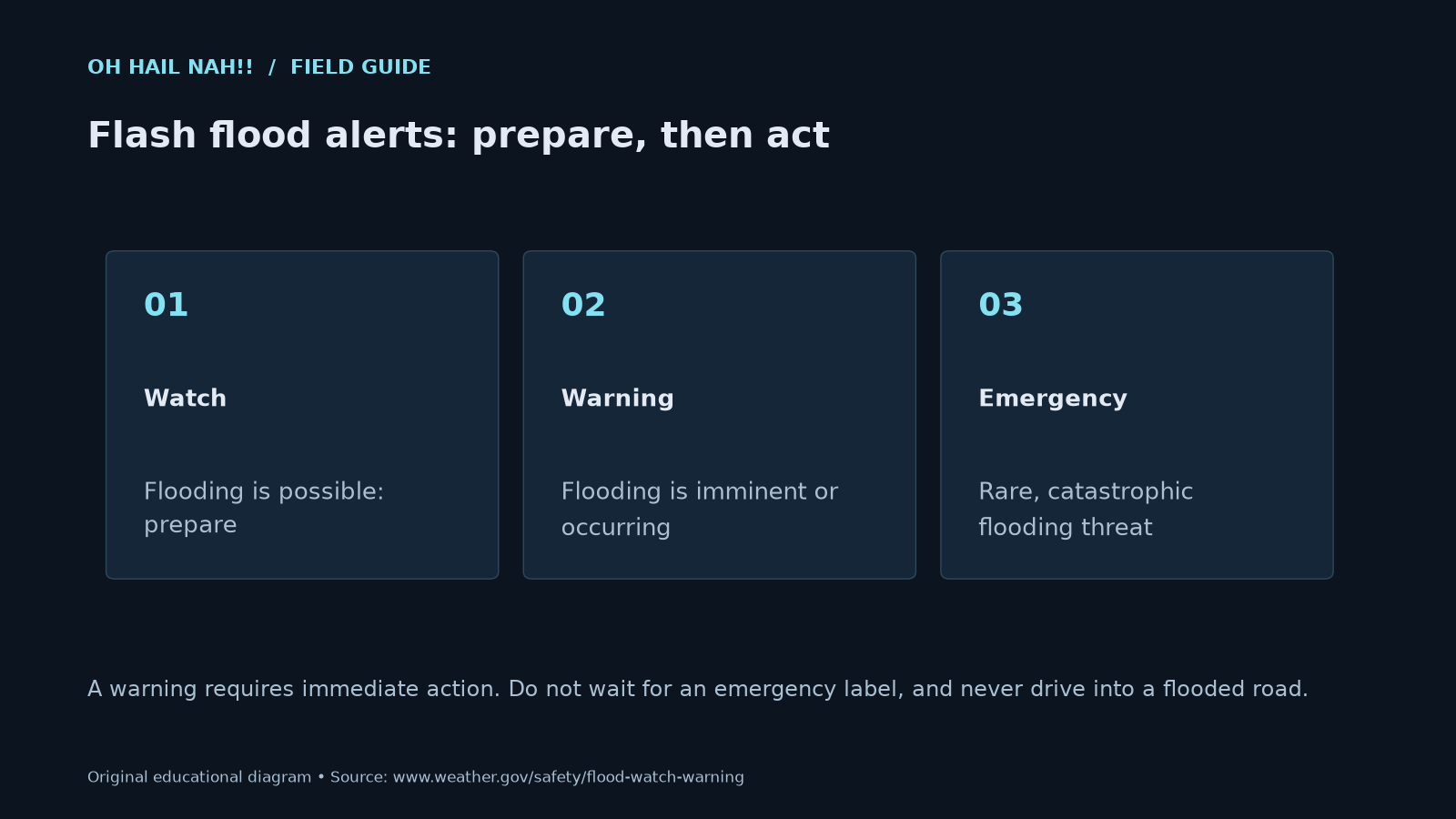
A warning requires immediate action. Do not wait for an emergency label, and never drive into a flooded road.
How the flood alerts escalate
A Flood Watch comes first, when conditions favor flooding. Once flooding is happening or imminent, the warning itself can carry three levels of damage threat. The top level is the emergency.
- Flood Watch
Heavy rain could cause flooding. Know your route to higher ground and keep your phone charged.
Phone alertNo - Flash Flood Warning
Flash flooding is occurring or imminent. Move to higher ground now. Used for most flash flood warnings.
Phone alertNo - Flash Flood Warning, “considerable” damage threat
Used rarely, when flooding of unusual severity is imminent or ongoing and urgent action is needed to protect lives and property.
Phone alertYes - Flash Flood Emergency (“catastrophic” damage threat)
Used exceedingly rarely. Severe threat to human life, catastrophic damage occurring or imminent, water at levels rarely if ever seen.
Phone alertYes
A NOAA Weather Radio broadcasts all of these. Your phone’s Wireless Emergency Alerts only fire for the considerable and catastrophic levels, which is why a standard Flash Flood Warning can arrive silently. Our guide to alerts that wake you up covers how to close that gap.
What changes when it becomes an emergency
The warning area may be similar. What changes is what forecasters and local officials know is happening on the ground. According to NWS guidelines, a Flash Flood Emergency may follow when:
- A local or state emergency manager confirms rapidly rising water is placing, or will place, people in a life-threatening situation.
- Swift-water rescue teams are being deployed or evacuations are underway.
- Water is reaching places that are normally safe, at major or rarely seen flood levels.
An emergency can cover part of one county or parts of several. If you are inside it, treat it as the flood equivalent of a tornado emergency: the danger is no longer possible, it is arriving.
How rare they are
Flash Flood Emergencies make up a small slice of flood alerts. Counts from the Iowa Environmental Mesonet, reported by The Weather Channel, show 29 in 2023, less than 1 percent of all flash flood alerts that year. 2024 had just over 90, and 34 of those came from Hurricane Helene’s flooding in the southern Appalachians. There were 55 in 2025.
Texas knows this alert well. Flash Flood Emergencies were issued during the July 4, 2025 Hill Country flood along the Guadalupe River, much of which struck before dawn, and again during flooding across Texas this July. Overnight flooding is exactly the case where a silent phone costs time.
Leave, or get higher where you are?
The answer depends on one thing: whether you can reach higher ground without going through moving water. This guidance comes from FEMA’s Ready.gov and the National Weather Service. Local officials’ instructions come first.
Get ready before the rain
- Know whether your home, workplace or campsite sits near a creek, low-water crossing or river that can rise fast.
- Pick your route to higher ground now, one that does not cross a low-water crossing.
- Keep documents in a waterproof container and your phone charged when heavy rain is forecast.
- Check your flood insurance. Homeowner’s policies do not cover flooding, and a new National Flood Insurance Program policy typically takes 30 days to take effect.
Our 24/7 live stream breaks in for Flash Flood Emergencies, and our storm kit checklist covers what to keep ready.
Questions people ask
What is the difference between a Flash Flood Warning and a Flash Flood Emergency?
A Flash Flood Warning means flash flooding is occurring or imminent and you should move to higher ground. A Flash Flood Emergency is issued within a warning in exceedingly rare situations when there is a severe threat to human life and catastrophic damage is happening or about to happen.
Will my phone alert me for a Flash Flood Warning?
Only for some. Wireless Emergency Alerts go out for Flash Flood Warnings with a “considerable” or “catastrophic” damage threat, which includes every Flash Flood Emergency. Standard flash flood warnings do not trigger a phone alert, so a NOAA Weather Radio or weather app is needed for those.
How is a flash flood different from a flood?
Flash floods develop quickly, usually within about six hours of heavy rain or a dam or levee failure, and can turn creeks and streets into fast-moving torrents. Other floods, such as river flooding, tend to build more slowly and last longer.
How much water does it take to sweep a car away?
According to the National Weather Service, 12 inches of rushing water can carry away most cars and 2 feet can carry away SUVs and trucks. Six inches of fast-moving water can knock an adult off their feet.
Should I go to the attic if my house floods?
Not a closed attic. FEMA advises getting to the highest level of the building but not climbing into a closed attic, where rising water can trap you. Go onto the roof only if necessary, and signal for help.
Keep reading
Sources
- NOAA National Severe Storms Laboratory, Severe Weather 101: Flood FAQ (damage threat levels).
- National Weather Service Mobile, Severe Weather Awareness: Flood safety.
- National Weather Service, Turn Around Don’t Drown®.
- FEMA Ready.gov, Floods.
- National Weather Service, Wireless Emergency Alerts FAQ.
- The Weather Channel, Flash flood emergency warnings: things to know about this rare alert (NWS criteria and annual counts).
- KENS 5, What is a Flash Flood Emergency? (July 2026 Texas flooding).
These guides support personal planning. They do not replace official warnings, emergency services or local evacuation orders. When a warning is in effect for you, act on it first and read later. Official forecasts and warnings: weather.gov.
