
HAIL REFERENCE
Hail size chart: from pea to softball.
What “quarter size” and “golf ball size” mean in inches, where the National Weather Service draws the line for severe hail, and which sizes set off a phone alert.
The short answer
The National Weather Service calls hail severe at 1 inch in diameter, about the size of a quarter. Warnings get a “considerable” damage tag at 1.75 inches (golf ball) and a “destructive” tag at 2.75 inches (baseball), and only the destructive tag sets off Wireless Emergency Alerts on phones. Forecasters treat hail 2 inches and larger as significant severe.
Hail diameter: measure the widest part
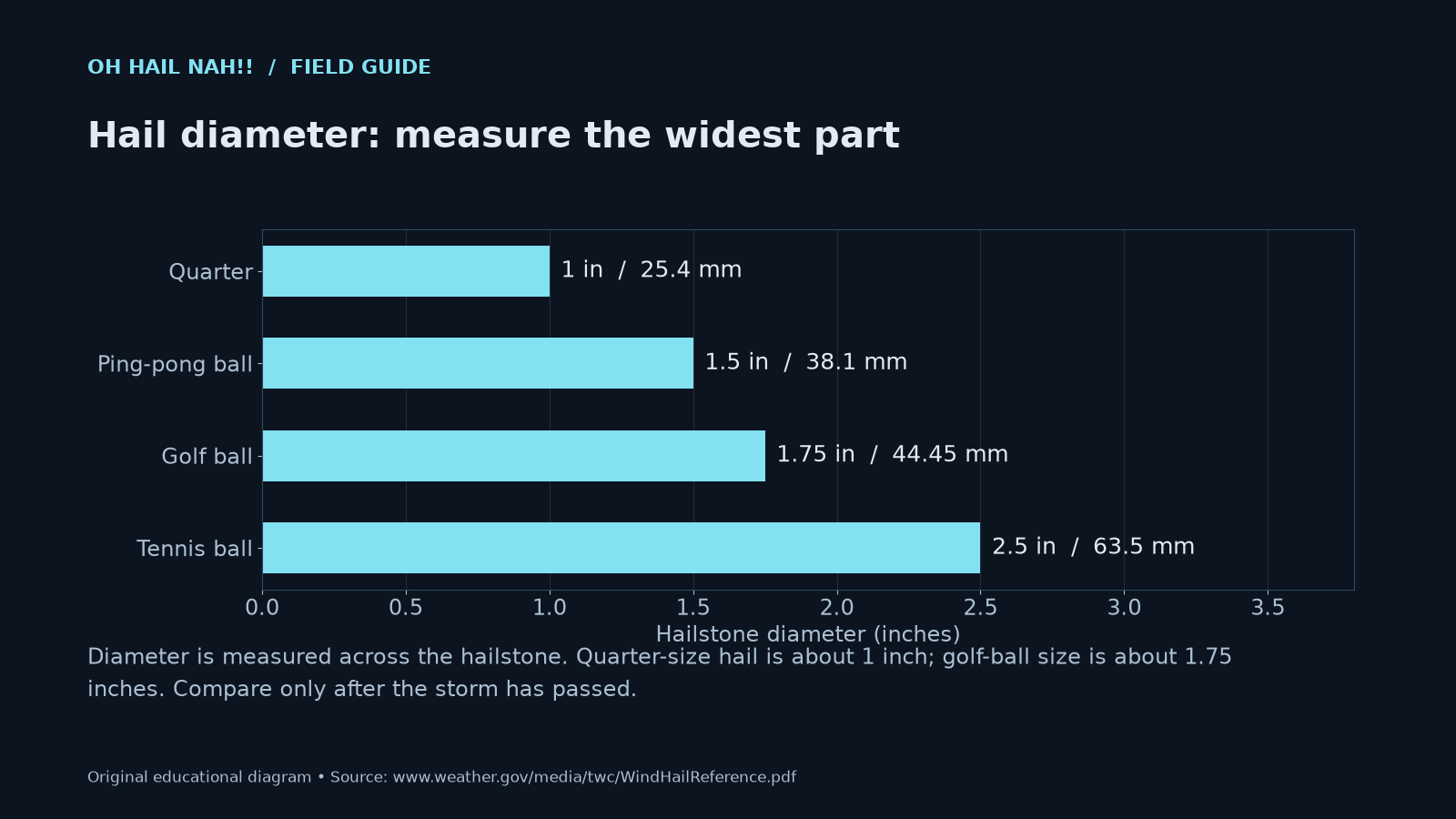
Diameter is measured across the hailstone. Quarter-size hail is about 1 inch; golf-ball size is about 1.75 inches. Compare only after the storm has passed.
Hail sizes, side by side
Drawn to scale with each other, not at actual size on your screen.
Hail size chart in inches and millimeters
Spotters and forecasters compare hail to everyday objects. These are the reference sizes the National Weather Service and NOAA’s National Severe Storms Laboratory use. Hail size means the diameter of the stone.
| Compared to | Inches | Millimeters | What it means in NWS terms |
|---|---|---|---|
| Pea | 0.25 | 6 | Small hail |
| Mothball or marble | 0.50 | 13 | Small hail |
| Dime | 0.70 | 18 | Below severe, still worth reporting |
| Penny | 0.75 | 19 | Below severe. This was the severe threshold before 2010. |
| Nickel | 0.88 | 22 | Below severe |
| Quarter | 1.00 | 25 | Severe. Meets Severe Thunderstorm Warning criteria. |
| Half dollar | 1.25 | 32 | Severe |
| Ping-pong ball | 1.50 | 38 | Severe |
| Golf ball | 1.75 | 44 | “Considerable” damage threat tag |
| Hen egg or lime | 2.00 | 51 | Significant severe hail |
| Tennis ball | 2.50 | 64 | Significant severe hail |
| Baseball | 2.75 | 70 | “Destructive” damage threat tag. Triggers a Wireless Emergency Alert. |
| Tea cup | 3.00 | 76 | Significant severe hail |
| Softball | 4.00 | 102 | Significant severe hail |
| Grapefruit | 4.50 | 114 | Significant severe hail |
Millimeters are rounded. Damage threat tags apply to Severe Thunderstorm Warnings; wind speed can also set the tag.
Why severe starts at 1 inch
Until January 2010, the National Weather Service called hail severe at three-quarters of an inch, about penny size. It raised the bar to 1 inch after research showed hail generally does not cause significant damage until it reaches about that size, and after concern that frequent warnings for smaller hail were teaching people to ignore them.
A Severe Thunderstorm Warning goes out when a storm is producing, or is about to produce, hail of 1 inch or larger or wind gusts of 58 mph or more.
Which hail sizes change the warning
Since August 2021, Severe Thunderstorm Warnings carry a damage threat tag. The tag tells you how bad the storm is expected to be, and it decides whether your phone goes off.
| Tag | Hail | Or wind | Phone alert (WEA) |
|---|---|---|---|
| Base (no tag shown) | 1.00″ (quarter) | 58 mph | No |
| Considerable | 1.75″ (golf ball) | 70 mph | No |
| Destructive | 2.75″ (baseball) | 80 mph | Yes |
The NWS says about 10 percent of severe thunderstorms reach the destructive level in an average year.
That is why golf ball hail can pound a neighborhood without a single phone going off. If you want to hear about every severe thunderstorm warning, you need a weather radio or an app. Our guide to alerts that wake you up walks through the setup.
On the forecast side, the Storm Prediction Center’s outlooks now mark areas where hail around 2 inches or larger is possible (Intensity Level 1) and where hail larger than 3.5 inches is possible (Intensity Level 2). Our guide to reading the new SPC maps explains the patterns.
How fast hail falls
Bigger stones fall faster. Research summarized by NOAA’s National Severe Storms Laboratory gives these rough ranges, with a lot of uncertainty from shape, melting and wind:
- Under 1 inch: about 9 to 25 mph
- 1 to 1.75 inches: about 25 to 40 mph
- 2 to 4 inches: about 44 to 72 mph
- Over 4 inches: can exceed 100 mph
Strong wind can drive hail sideways, which is how it breaks side windows on cars and houses and tears up siding. When a warning includes large hail, get inside a sturdy building and stay away from windows.
How to measure hail for a report
Coin comparisons are handy but rounded. A real quarter is 0.955 inches across, a nickel 0.835 and a dime 0.705, while the hail chart calls them 1.00, 0.88 and 0.70. A ruler or tape measure beats a coin every time.
- Wait until the hail has stopped and lightning has moved on. No report is worth going out in the storm.
- Find the largest stone you can and measure across its widest point.
- Photograph it next to a ruler, then note the time and location.
- Report it with NOAA’s free mPING app or to your local National Weather Service office. Reports help forecasters check what radar is showing.
Where hail is most common
Florida has the most thunderstorms, but the most hail days happen where Nebraska, Colorado and Wyoming meet, an area known as hail alley that averages seven to nine hail days a year. The largest hailstone recovered in the United States fell in Vivian, South Dakota, on July 23, 2010. It measured 8 inches across and 18.62 inches around, and weighed 1 pound 15 ounces.
What gear can and cannot do
No product makes you hail-proof, and we will not pretend otherwise. Here is where gear fits:
- A weather radio or phone alert gets you the warning. Getting the car into a garage and yourself away from windows is what prevents the damage. See the Midland WR400 buying notes.
- A charged phone documents damage. Photos with a ruler and a timestamp help when you file an insurance claim.
- A flashlight and a stocked kit matter when hail knocks out power. Our storm kit checklist covers the basics.
Questions people ask
What size hail is considered severe?
The National Weather Service considers hail severe at 1 inch in diameter, about the size of a quarter. Before January 2010 the threshold was three-quarters of an inch.
How big is golf ball size hail?
Golf ball hail is 1.75 inches (about 44 mm) in diameter. At that size the National Weather Service adds a “considerable” damage threat tag to a Severe Thunderstorm Warning.
Why didn’t my phone alert me for golf ball hail?
Phones receive a Wireless Emergency Alert for a severe thunderstorm only when the warning carries the “destructive” tag: hail at least 2.75 inches (baseball size) or wind at least 80 mph. Golf ball hail earns the “considerable” tag, which does not trigger a phone alert.
What size hail damages roofs and cars?
There is no single number. Damage depends on the hail size, how hard the wind is driving it, and the age and material of the roof or vehicle. Severe thunderstorm warnings for larger hail typically say to expect hail damage to roofs, siding, windows and vehicles.
What is the largest hailstone ever found in the U.S.?
The record hailstone fell in Vivian, South Dakota, on July 23, 2010. It was 8 inches in diameter, 18.62 inches in circumference and weighed 1 pound 15 ounces.
Keep reading
Sources
- NOAA National Severe Storms Laboratory, Severe Weather 101: Hail basics.
- National Weather Service, Wind and hail size reference (spotter chart).
- National Weather Service, “Destructive” Severe Thunderstorm Warning category.
- National Weather Service, SPC’s Conditional Intensity shines a light on the most violent weather.
- U.S. Mint, Coin specifications.
- Wikipedia, Severe thunderstorm warning (2010 criteria change).
- National Weather Service Aberdeen, Vivian record hail event, July 23, 2010.
These guides support personal planning. They do not replace official warnings, emergency services or local evacuation orders. When a warning is in effect for you, act on it first and read later. Official forecasts and warnings: weather.gov.
